Did You Know the clothes you wear can increase your risk of Cancer?
We think a lot about what we put into our bodies. We reach for organic produce, double-filter our drinking water, and carefully scan beauty labels for parabens and sulfates. But do we ever give that same scrutiny to what we put onto our bodies for 24 hours a day?
The sobering reality is that modern clothing has transformed from a simple protective layer into a complex, chemically treated material. Your skin isn't a solid, impenetrable wall; it is your body’s largest, most porous organ. It breathes, it absorbs, and right now, the fabrics hanging in your closet might be silently contributing to health issues ranging from minor skin irritations, allergies, itching and rashes to potential long-term endocrine and cellular disruptions.
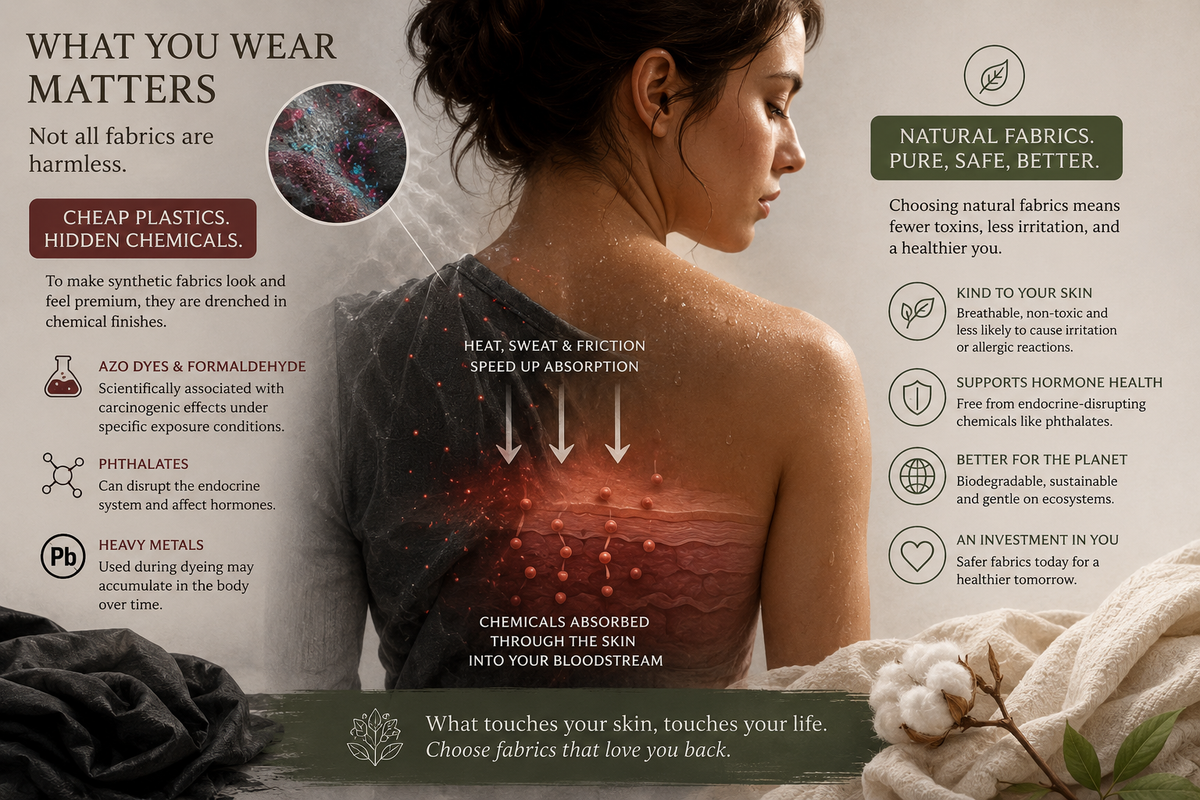
The core of the issue lies in the rapid rise of fast fashion. According to the United Nations Environment Programme (UNEP, 2025), the share of synthetic fibers in our clothing has ballooned from just 3% in 1960 to nearly 68% today. Walk into any mass-market store, and roughly 70% to 80% of what you see is made from petroleum-based synthetics such as polyester, nylon, acrylic, and spandex. And to make these cheap plastics feel premium, they are drenched in chemical finishes to render them wrinkle-resistant, stain-proof, or unnaturally stretchy. Certain azo dyes and formaldehyde have been scientifically associated with carcinogenic effects under specific exposure conditions, while phthalates can disrupt the endocrine system and certain heavy metals used during dyeing may accumulate in the body over time. The combination of body heat, sweat, and friction acts as a catalyst, accelerating the dermal absorption of these chemicals straight into your bloodstream. This is why choosing safer, natural fabrics can be an investment in both your body and the environment.
Why choose handloom over machine made?
As highlighted by the BBC, the fast fashion industry is responsible for approximately 10% of global carbon emissions and 20% of waste water heavily driven by the toxic runoff of synthetic dyeing units. Every single year, washing machine cycles release about 500,000 tons of synthetic microfibers into our oceans. These particles do not biodegrade, they just circle back into the food chain. Hence, machine-made synthetic textile production is an ecological disaster.
There is a clean, living alternative.
Choosing natural, hand-woven fabric isn't just a stylistic pivot but it's a holistic investment across five critical areas: human health, environmental protection, community economics, social inclusion, and cultural preservation.
Handloom fabrics are highly breathable, use natural dyes so have zero toxic residues and are completely safe on skin. Because they are woven manually, handlooms consume little to no electricity during weaving. Natural fibres are also safely biodegradable without leaving behind plastic residues unlike polyester, which can take hundreds of years to break down.
India's handloom sector supports the livelihoods of over 3.5 million people, many of whom are women and members of economically vulnerable communities. Unlike highly automated manufacturing, handloom weaving relies on skilled human hands.
The industry is also inherently collaborative, bringing together weavers, dyers, spinners, and artisans whose expertise has been passed down through generations.
India's weaving traditions are among the richest in the world. Every region has its own identity woven into fabric from Banarasi in Uttar Pradesh, Chanderi and Maheshwari in Madhya Pradesh, Jamdani in West Bengal, Kanchipuram in Tamil Nadu and the list goes on. These are not simply textiles, they are living expressions of regional history, culture, motifs, and identity that machines cannot truly replicate.